
The word pyramid often makes people think of big Egyptian buildings. But pyramids are also neat shapes in math. This article will explain the formula for volume of a pyramid step by step. I will use simple words and short sentences. You will read clear examples and real-life uses. I will show how to find the base area and height. I will also give tricks to avoid mistakes. By the end you will know how to solve many pyramid volume problems. I once helped a fifth grader learn this in one afternoon. That student loved the visual tricks I used. You can do this too, even if math feels hard now.
What is a pyramid?
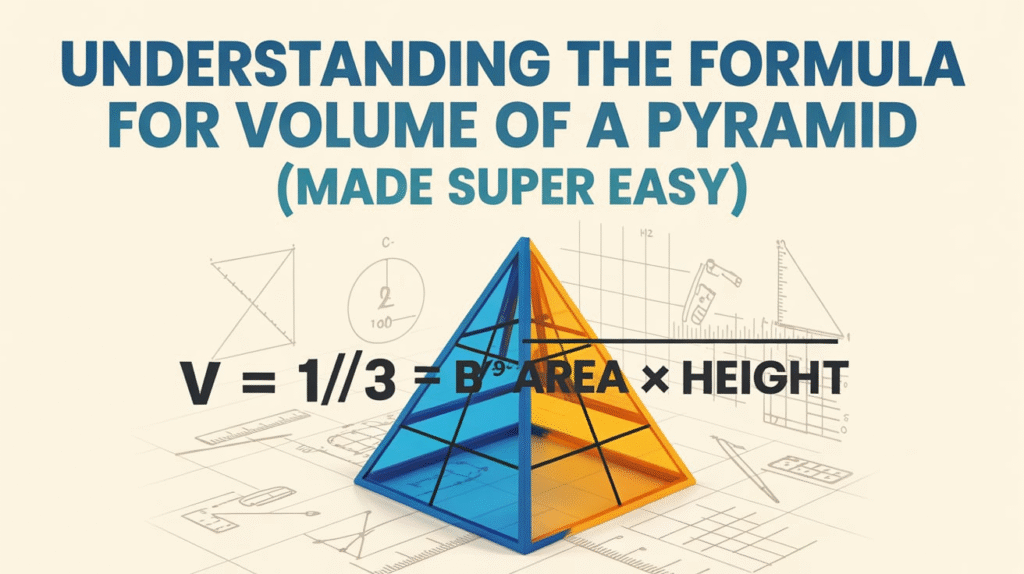
A pyramid is a three-dimensional solid. It has a flat base. It also has triangular faces that meet at a point called the apex. The base can be any polygon. The base might be a square, rectangle, triangle, or another shape. The height is the straight-line distance from the base up to the apex. That line must meet the base at a right angle. You must know the base area and the height to find volume. The shape shrinks as triangles meet the top. Many real objects look like pyramids. Examples include tents and some rooftops.
The formula for volume of a pyramid — simple form
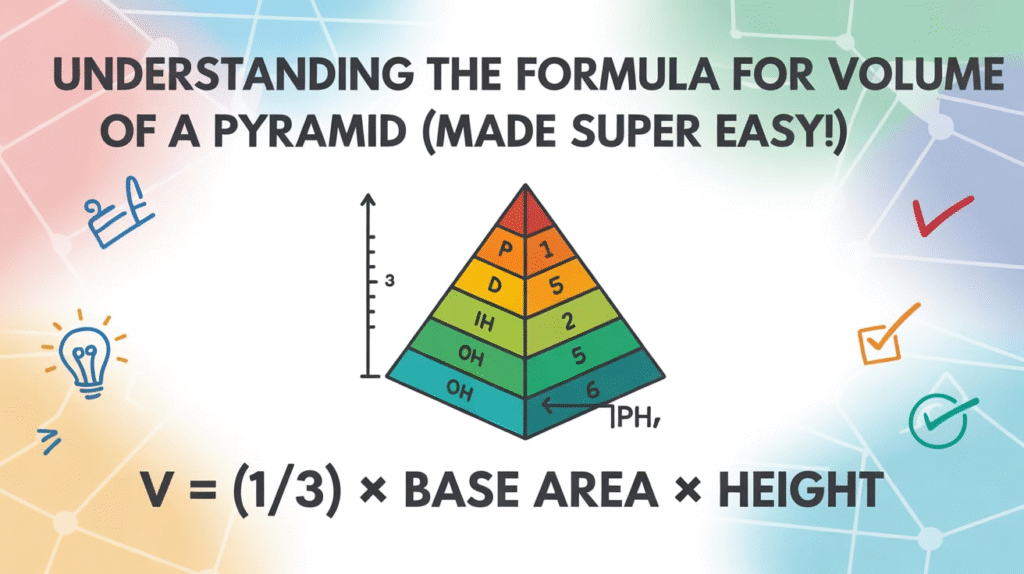
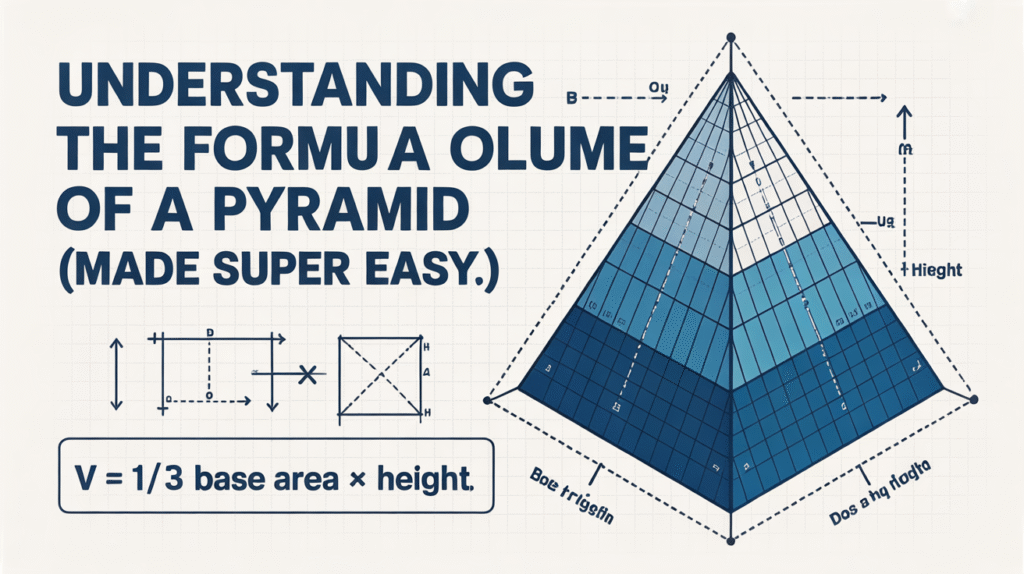
The formula for volume of a pyramid is short and neat. It says volume equals one third times base area times height. In symbols we write V=13×B×hV = \tfrac{1}{3} \times B \times hV=31×B×h. Here BBB stands for the base area. The letter hhh stands for the height. This formula works for any pyramid, no matter the base shape. Knowing BBB and hhh is enough. You do not need the slant height for volume. Use the base area that fits the base shape. Multiply, then take one third. That gives the volume.
Why one third? A simple explanation
Why does the formula include one third? Imagine stacking three identical pyramids. If their bases and heights match, they will fill one prism with the same base and height. A prism has volume B×hB \times hB×h. Three identical pyramids make that prism. So each pyramid has one third of the prism volume. This idea works for many base shapes. The key is that the prism and pyramid share the same base and height. That gives an intuitive reason for the one third. No heavy calculus is needed to see this idea.
How to find the base area BBB
You must find the base area BBB before using the formula for volume of a pyramid. The method depends on the base shape. If the base is a square, use side squared. If it is a rectangle, multiply length by width. If it is a triangle, use half times base times height of that triangle. For a regular polygon, use area formulas for that polygon. For circles you would not have a pyramid base, but cones use circle area. Remember to use the same units for all measurements. If the base is made of smaller shapes, add their areas. Accurate base area makes volume correct.
Units and converting them correctly
Units matter. If the base area is in square meters, the volume will be in cubic meters. Use consistent units for length. If height is in centimeters, change it to meters when base is in meters. To convert area units, square the conversion factor. For example, 100 cm equals 1 m. So 10,000 square cm equals 1 square meter. For volume, cube the conversion factor. For example, 1000 cubic cm equals 1 cubic decimeter. Always check units before finalizing your answer. Units tell you what the number really means.
Example 1: square base, easy numbers
Let us do a simple problem. The base is a square with side 6 units. The height is 9 units. First, find base area. For a square, area equals side squared. So B=6×6=36B = 6 \times 6 = 36B=6×6=36 square units. Now apply the formula for volume of a pyramid. Multiply base area by height, then take one third. So volume V=13×36×9V = \tfrac{1}{3} \times 36 \times 9V=31×36×9. Multiply 36 by 9 to get 324. One third of 324 equals 108. The pyramid volume is 108 cubic units. Check units: area was square units and height was units, so result is cubic units.
Example 2: triangular base with fractions
Now try a triangle base. The triangle base has base length 8 units. Its triangle height is 5 units. The pyramid height is 12 units. First find the triangle area. Triangle area equals half times base times height. So B=12×8×5=20B = \tfrac{1}{2} \times 8 \times 5 = 20B=21×8×5=20 square units. Use the formula for volume of a pyramid next. Multiply BBB by height, then take one third. That gives V=13×20×12V = \tfrac{1}{3} \times 20 \times 12V=31×20×12. Multiply 20 by 12 to get 240. One third of 240 equals 80. The volume is 80 cubic units. This example shows how to handle a triangular base before using the pyramid volume formula.
Step-by-step method you can use every time
Here is a short step list you can follow. Step 1: Identify the base shape. Step 2: Find the base area BBB with the correct formula. Step 3: Measure or identify the height hhh. Step 4: Plug into the formula for volume of a pyramid: V=13BhV = \tfrac{1}{3}BhV=31Bh. Step 5: Do the arithmetic and include units. Step 6: Check your result for reasonableness. If the number seems too large or small, re-check units and calculations. Saying the steps aloud can help. Doing a sketch also helps many learners.
Common mistakes and how to avoid them
Students make some common mistakes with pyramid volume. One is using slant height instead of vertical height. The formula for volume uses the vertical height. Another mistake is mixing units. Always convert units to match. A third mistake is wrong base area. Double-check the base area formula for your base. Also be careful with fractions from triangle areas. Write down each step clearly. A final tip is to estimate the answer first. If your final number is far from the estimate, re-check work. These habits cut down errors fast.
Visualizing the pyramid and the prism trick
A strong way to learn is to visualize. Draw the base. Sketch a vertical line up to the apex. Now imagine copying the pyramid two more times. Place them carefully so their bases align to form a prism. This shows why the formula for volume of a pyramid has one third. Visual models make abstract rules feel real. You can also model with clay or paper. Cut a paper prism and fold pyramids to compare volumes. Feeling the shapes helps memory. Try building a small model at home for hands-on learning.
Relation to cones and other solids
Pyramids are cousins of cones. A cone has a circular base and a point at the top. Its volume formula is similar. For a cone, the volume is one third times the base area times height. The only difference is the base area is a circle. This shows a shared idea across shapes. Prisms and cylinders differ because they do not have the one third factor. This relation helps when you study many solids. Knowing the family of formulas makes math easier. It shows patterns between shapes and their volumes.
Real-world uses for the formula
People use the formula for volume of a pyramid in many fields. Architects use it when working with roof shapes or sculptures. Gardeners might use it to calculate soil for a tapered raised bed. Engineers use it for parts that taper to a point. In arts, sculptors estimate material needed with the formula. Teachers use it for classroom projects. Even game designers may use it to combine 3D models. Learning the formula helps in many jobs and hobbies. Showing real uses builds trust in the math.
Practice problems with answers
Practice helps learning stick. Here are three problems to try on your own. Problem A: Square base side 10 units. Height 15 units. Problem B: Triangular base with triangle base 6 units and triangle height 4 units. Pyramid height 9 units. Problem C: Rectangular base 8 by 5 units. Height 7 units. Work them out using the formula for volume of a pyramid. Answers: A: B=100B=100B=100; V=13×100×15=500V=\tfrac{1}{3}\times100\times15=500V=31×100×15=500 cubic units. B: B=12×6×4=12B=\tfrac{1}{2}\times6\times4=12B=21×6×4=12; V=13×12×9=36V=\tfrac{1}{3}\times12\times9=36V=31×12×9=36 cubic units. C: B=40B=40B=40; V=13×40×7≈93.333V=\tfrac{1}{3}\times40\times7\approx93.333V=31×40×7≈93.333 cubic units.
Advanced note: short idea of calculus proof (optional)
If you like deeper ideas, calculus gives a full proof. It slices the pyramid into many thin layers. Each layer is a scaled copy of the base. The layers have tiny thickness. Integrating the area of each layer across the height gives the total volume. The integral yields the one third factor exactly. You do not need to know calculus to use the formula. But if you study integrals later, you will see the same result. Think of the integral as adding many thin prisms. That idea connects algebraic rules to continuous change.
Tips to explain this to kids (teacher or parent)
Keep examples small and visual for kids. Use playdough or blocks to build shapes. Show three small pyramids fitting into a prism. Use colored paper to draw bases and the apex. Break steps into simple instructions. Praise each correct step for confidence. Use everyday objects for scales. Tell a short story about a pyramid-shaped tent or tower. Ask simple questions to check understanding. Use the formula for volume of a pyramid with small whole numbers. This builds early success and avoids frustration.
Quick cheat sheet (one-page memory aid)
Here is a tiny cheat sheet you can copy. Write down the formula for volume of a pyramid: V=13BhV = \tfrac{1}{3}BhV=31Bh. Under that, list base area formulas: square: s2s^2s2; rectangle: l×wl\times wl×w; triangle: 12bh\tfrac{1}{2}bh21bh. Add a note: use vertical height, not slant height. Add a units reminder: volume in cubic units. Add a quick estimate tip: find prism volume BhBhBh then divide by three. Keep this cheat sheet in your notebook. It saves time during homework and tests.
Conclusion — what to do next
You now know the formula for volume of a pyramid. You can find base area, use height, and get volume. Try the practice problems and create one of your own. Build a small model or draw a diagram to test your skills. Use the cheat sheet when practicing. If you tutor someone, teach them the prism trick to show why the formula works. Math grows with practice and clear steps. Keep questions coming if you want more examples. I enjoyed writing this and hope you feel ready to use this handy formula in class or real life.
Frequently Asked Questions (6)
FAQ 1: What is the formula for volume of a pyramid in words?
The formula for volume of a pyramid is one third times the area of the base times the height. Say it aloud to remember it. Use base area, not slant area. Multiply base area by height first. Then take one third of that product. The units become cubic units.
FAQ 2: Can I use slant height in the formula?
No. The formula for volume of a pyramid needs the vertical height. The slant height is the length along a triangular face. Slant height helps find surface area. For volume, measure straight up from the base to the apex at a right angle.
FAQ 3: Does the base have to be a square?
No. The base can be any polygon. Use the correct area formula for that polygon. The pyramid formula works for triangular, rectangular, and other polygonal bases. For circular bases you get a cone, which uses the same one third rule with circle area.
FAQ 4: How do units change when finding volume?
If you use meters for length, area will be square meters. Multiply by height in meters to get cubic meters. Always use the same length units for area and height. Convert units before you multiply. For example, change centimeters to meters if needed.
FAQ 5: How can I check my answer?
Estimate first by comparing to a prism with the same base and height. A pyramid should be about one third of that prism. If your result is close to one third, it likely is correct. Also re-check base area and height for mistakes and confirm units.
FAQ 6: Is the formula proven or just a rule?
The formula for volume of a pyramid is proven. You can see a simple proof with three pyramids making a prism. A more advanced proof uses calculus and integration. Both show the one third factor exactly. The rule is both useful and well-founded.