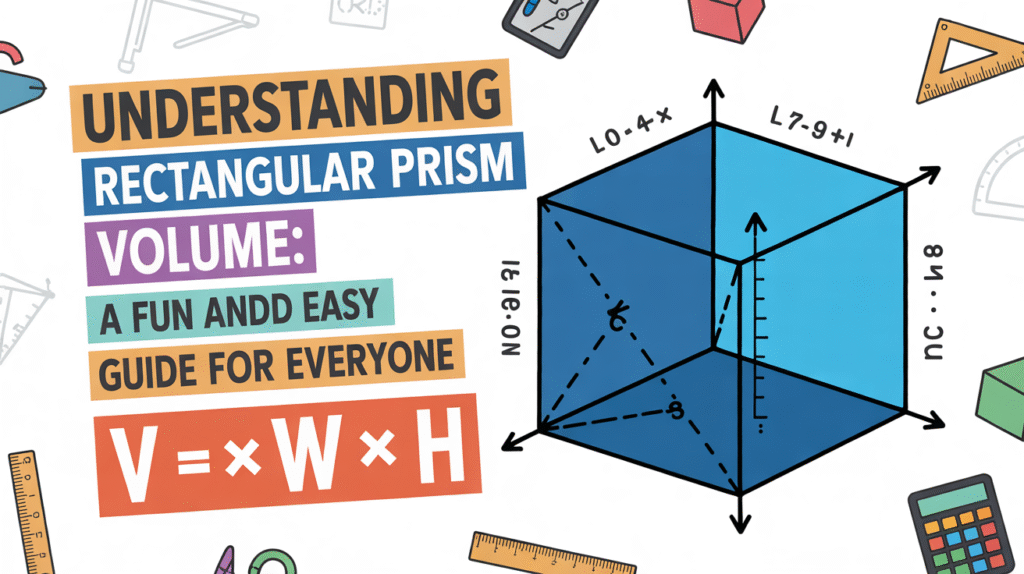

Have you ever looked at a box and wondered how much space it holds inside? That’s what we call its volume! Knowing how to find the rectangular prism volume
is super useful in real life. From packing gifts to building a bookshelf, volume helps us understand how much space something takes up.
When I was helping my younger cousin with math homework, she asked me, “Why do I need to learn this?” I smiled and showed her that volume is all around us — in cereal boxes, fish tanks, and even our rooms. Once you understand it, you start seeing rectangular prisms everywhere!
In this guide, we’ll learn what a rectangular prism is, how to find its volume, and why it matters in daily life. Don’t worry — we’ll take it step by step, in a fun and simple way.
Table of Contents
What Is a Rectangular Prism?
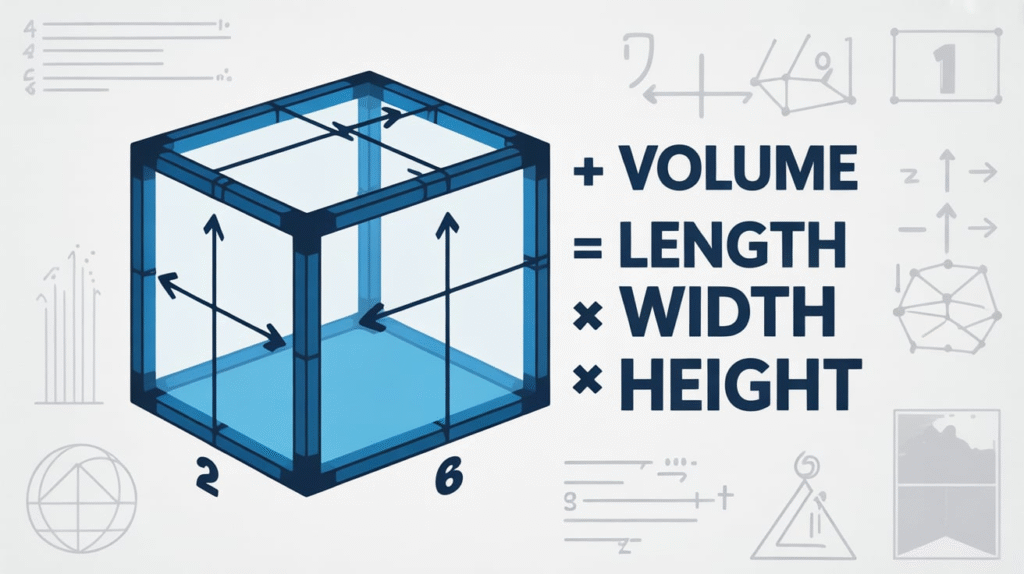
A rectangular prism is a 3D shape that looks like a box. It has six sides, and every side is a rectangle. Think about a shoebox, a cereal box, or even a refrigerator — these are all examples of rectangular prisms.
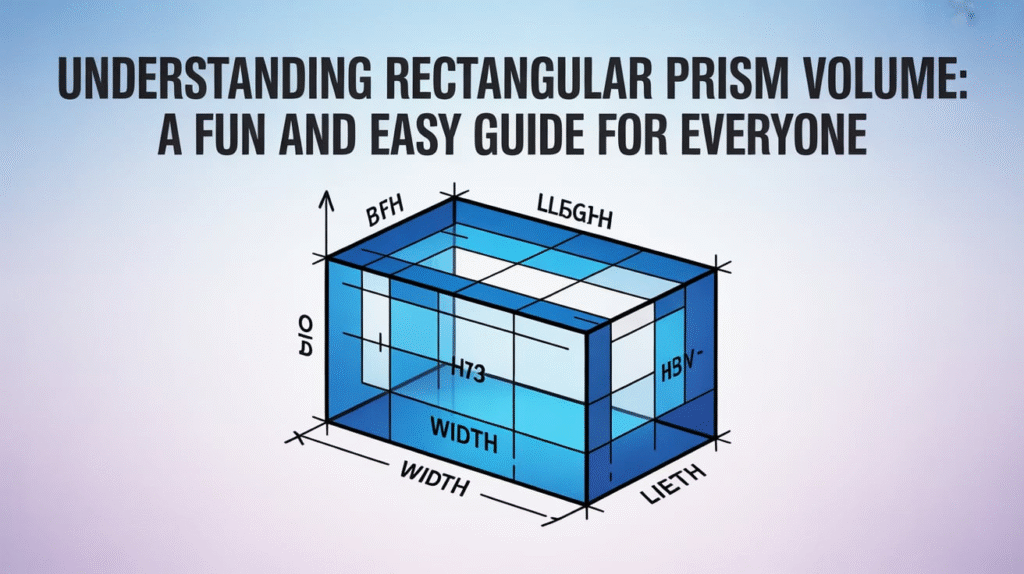
Every rectangular prism has three main parts: length, width, and height. These measurements tell us how long, wide, and tall the shape is. When we multiply those three numbers together, we find the rectangular prism volume — or how much space is inside the box.
If you can imagine stacking cubes inside the box until it’s full, that’s exactly what you’re doing when you find its volume. The total number of cubes tells you the space inside — pretty cool, right?
Why Learn About Rectangular Prism Volume?
At first, it might seem like something you only use in math class. But learning about rectangular prism volume is a life skill! You use it more than you think.
Imagine buying an aquarium for your fish. You need to know how much water it can hold — that’s volume. Or when you’re baking a cake and want to fill a rectangular pan, knowing the volume helps you measure ingredients correctly.
Builders, engineers, and designers use this math every day. Even packing a moving truck requires knowing how many boxes fit inside — that’s all about volume! So, by learning this, you’re not just doing schoolwork — you’re getting ready for real-life problem-solving.
The Simple Formula for Rectangular Prism Volume
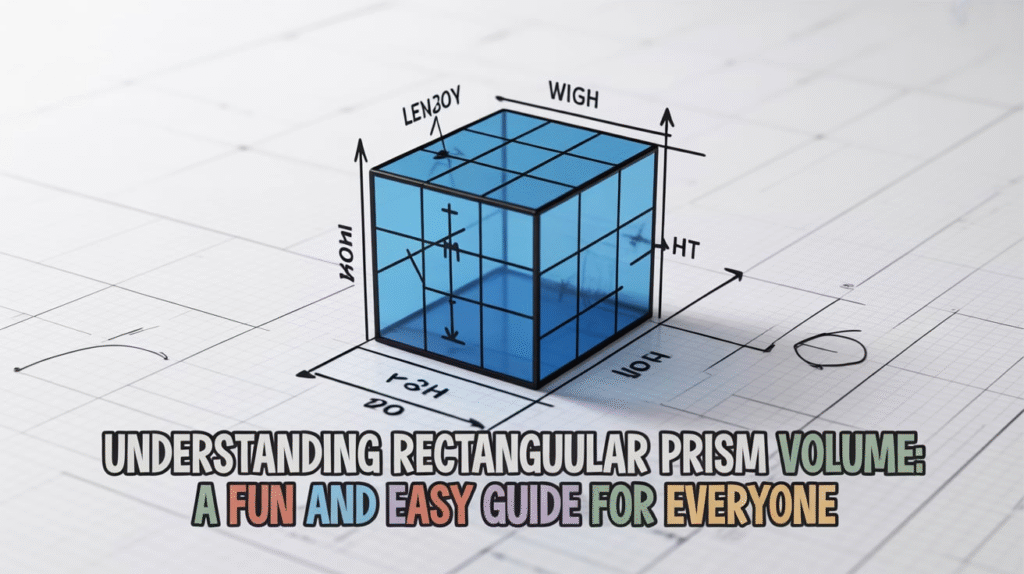
Let’s keep things easy. The formula to find the rectangular prism volume is:
Volume = Length × Width × Height
That’s it! You just multiply the three measurements. But here’s something important — make sure all your measurements use the same units (like centimeters or inches).
For example, if a box is 5 cm long, 3 cm wide, and 2 cm tall, the volume is:
5 × 3 × 2 = 30 cubic centimeters.
The word cubic means the shape is measured in cubes. So your answer tells you how many little cubes can fit inside your box. Once you get the hang of it, it becomes second nature — like counting steps!
Understanding Units: Cubic What?
When we talk about volume, we use cubic units. That means we’re measuring in cubes that are 1 unit on each side.
If your box’s sides are measured in centimeters, your volume is in cubic centimeters (cm³). If they’re in inches, then it’s cubic inches (in³).
This matters because using different units can change your answer. For instance, a box that’s 10 cm long isn’t the same size as one that’s 10 inches long. Always check your units before you start!
When you write your answer, remember to add that little “³” symbol — it shows you’re talking about three-dimensional space, not just length or area.
Step-by-Step: How to Find Rectangular Prism Volume
Let’s go through an example together. Suppose we have a gift box that’s 8 inches long, 4 inches wide, and 3 inches tall.
Step 1: Write down what you know.
Length = 8 in, Width = 4 in, Height = 3 in.
Step 2: Multiply them.
8 × 4 × 3 = 96.
Step 3: Add the units.
The volume is 96 cubic inches.
That’s it! The box can hold 96 cubes that are 1 inch on each side. Once you practice a few times, you’ll see that finding rectangular prism volume is as easy as ABC.
Real-Life Examples of Volume
Volume isn’t just for math homework — it’s everywhere!
When you pour milk into a rectangular carton, you’re filling up its volume. When you buy a new bookshelf, the maker had to figure out how much space each shelf can hold. Even when building houses, workers calculate the volume of rooms for heating and cooling systems.
My favorite example is a swimming pool. If you know the rectangular prism volume, you can calculate how much water it needs. That helps you plan how much time it will take to fill and how much chlorine you’ll need later.
So next time you see a box, take a guess — what might its volume be?
Using Rectangular Prism Volume in Science
Did you know scientists use rectangular prism volume all the time? In labs, researchers measure how much space a liquid or gas takes up inside a container. Knowing the exact volume helps them mix chemicals safely and accurately.
Even astronauts need to know about volume when packing supplies for space missions. They must fit food, water, and tools into limited space — just like fitting boxes into a rocket!
By understanding how to measure space, scientists and engineers can design better products and tools for the world. So, when you learn this, you’re learning a skill that even NASA uses.
Common Mistakes When Finding Volume
Everyone makes mistakes when learning math, and volume is no different. Here are a few things to watch out for:
- Mixing up units: Always check if your measurements are in the same unit.
- Forgetting to multiply one side: Remember, volume has three dimensions — length, width, and height.
- Skipping the cubic unit: Don’t forget to write cm³, m³, or in³ after your answer.
If you double-check these steps, you’ll get the correct rectangular prism volume every time. I always tell my students: “Math isn’t about being perfect — it’s about being careful.”
How Volume Relates to Area and Perimeter
Volume, area, and perimeter are like three math cousins. They’re related but measure different things.
- Perimeter tells you the distance around a shape.
- Area measures the space inside a flat shape.
- Volume measures the space inside a 3D shape.
If you can find the area of a rectangle, you’re already halfway to finding rectangular prism volume! You just take that area and multiply by the height. Simple as that.
Understanding how these connect makes math easier and helps you see how shapes work in the real world.
Fun Ways to Practice Volume at Home
Math doesn’t have to be boring! You can practice finding rectangular prism volume with simple objects at home.
Try measuring cereal boxes, tissue boxes, or even toy blocks. Write down their length, width, and height, then find the volume. Compare them — which holds more space?
You can also build your own boxes using paper or cardboard. Guess their volume before measuring — it’s a great way to test your math sense.
Learning by doing makes math stick in your mind. Plus, it’s fun to see how everyday items connect to what you learn in school.
How Rectangular Prism Volume Helps in Careers
It might surprise you, but many jobs use rectangular prism volume every day.
Architects use it to design buildings. Engineers need it for machines. Interior designers measure space when planning rooms or furniture. Even store owners use it when deciding how to arrange boxes and shelves.
By mastering this concept now, you’re setting yourself up for future success. Understanding volume builds your problem-solving skills — and that’s valuable in any career.
Advanced Twist: Irregular Shapes
Sometimes, shapes aren’t perfect boxes. What do you do then?
You can still estimate rectangular prism volume by breaking the shape into smaller boxes. Find the volume of each small box, then add them together.
This is called decomposition — taking a big shape and splitting it into parts. Architects and engineers do this all the time when designing complex structures.
So even when shapes get tricky, the same simple formula can help you find your way.
FAQs About Rectangular Prism Volume
1. What’s the difference between area and volume?
Area measures flat space. Volume measures 3D space. A floor has area, but a box has volume.
2. Why do we use cubic units?
Because volume measures cubes, not squares. Each cube fills part of the 3D space inside the prism.
3. Can a rectangular prism have decimals in its measurements?
Yes! Real-life objects often have decimal measurements. Just multiply normally — you’ll still find the rectangular prism volume.
4. What happens if I switch length and width?
It doesn’t change the answer. Since multiplication can happen in any order, the volume stays the same.
5. How do I find volume if one side is missing?
You can rearrange the formula. Divide the volume by the other two sides to find the missing measurement.
6. How do I explain volume to a younger child?
Tell them it’s “how much fits inside a box.” You can even show them with toy cubes or blocks for fun learning.
Conclusion: You’re Now a Volume Expert!
See? Finding rectangular prism volume isn’t hard at all. It’s just multiplying three numbers to see how much space a shape holds. Whether you’re stacking boxes, baking, or building something new, you’re using math in amazing ways.
The more you practice, the more natural it feels. Try looking around your room — find a few boxes and guess their volume. Then measure to see if you were close!
Understanding this simple concept gives you confidence, not just in math but in real-life problem-solving too. So grab a ruler, find a box, and start exploring the wonderful world of volume!